

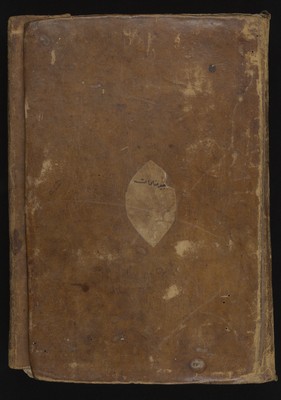
Kitāb mafātīḥ al-raḥmah wa-asrār al-ḥikmah
كتاب مفاتيح الرحمة و أسرار الحكمة · Part II has title : Mafātīḥ al-ḥikmah
- লেখক
- zosimos; ṭughrāʼī, al-ḥusayn ibn ʻalī
- ভাষা
- আরবি
- লিপিকাল
- 17??
- গ্রন্থাগার
- Library of Congress, Washington
- শেলফমার্ক
- QD25 .T847 1700z
চাকা ঘুরিয়ে বা দুই আঙুলে বড়-ছোট করুন, টেনে সরান; ← → দিয়ে পাতা উল্টান। ছবির স্বত্ব সংশ্লিষ্ট গ্রন্থাগারের।
পরিচিতি
Part II entitled "From keys of wisdom" is divided into 7 sections: Definitions and symbols; Promotion and what can be promoted; Distillation, what cannot be distilled; Conversions and synthesis; Degradation and decomposition; How the chemist deduced these facts; and, The stages of work. It is hard to consider this part an accurate translation of Zosimos book "Keys of the craft". It often contains references that are anachoronistic or that are not found in Zosimos' text. The ms. is in two parts. Part I, or Introduction by Ṭughrāʼī, and Part II, "From keys of wisdom" is by the Egyptian chemist Zosimos, translated into Arabic by al-Ṭughrāʼī. Part I is written in the form of lectures and is divided into 5 chapters: The science and its materials; Mixing and its way; Fire and its nature; Balances (of properties); Metals and plants and how to recognize them. This manuscript is an invaluable source for understanding alchemical doctrines and practices in the Islamic world during the Middle Ages. Its author, the polymath Muʻayyad al-Dīn al-Tuġrā'ī, was born in 1062 AD in Persia (present-day Iran) and worked as a secretary in the Seljuk court. He later was appointed vizier in Mosul (present-day Iraq), but his career came to a dramatic end in 1121, when, following the disgrace of his protector, he was falsely accused of heresy and beheaded. Notes on al-Tuġrā'ī's biography were added to the first page of this manuscript at a later date, together with some marginalia intended to correct, highlight, or comment upon particular passages of the treatise. Kitāb mafātīh ar-rahma wa-asrār al-hikma (The keys of mercy and the secrets of wisdom) consists of two parts. The first half of the treatise is a muqaddima (long introduction), in which the author presents a systematic exposition of alchemical doctrines, from the theory of the four elements to the preparation of a white elixir for the transmutation of copper into silver and of a red elixir for the transmutation of silver into gold. The second part of the manuscript contains al-Tuġrā'ī's Arabic translation of a Greek treatise by the famous alchemist Zosimus of Panopolys, who flourished around 300 AD. Al-Tuġrā'ī interpolates the text with his own comments and with quotations from other authorities (including philosophers such as Artistotle, Democritus, and Galen and mythical or historical characters such as Hermes and Cleopatra) to the extent that it is difficult to identify much of the original Greek work. Nonetheless, the very existence of this translation says much about role of Arabic sciences in the preservation and transmission of ancient and Hellenistic scientific knowledge. The manuscript is embellished with numerous drawings of chemical apparatuses, including vessels for distillation and sublimation and different kinds of furnaces, and tables intended to explain the theoretical contents of the text. World Digital Library.
পাঠকের মন্তব্য (০)
এখনও কোনো মন্তব্য নেই। প্রথম মন্তব্যটি আপনিই করুন।
ছবিসহ ও লিংকসহ মন্তব্য অ্যাডমিন দেখে প্রকাশ করেন।
আরও পাণ্ডুলিপি
 ফারসি[Collection of astronomical texts].
Ṭūsī, Naṣīr al-Dīn Muḥammad ibn Muḥammad,… · Princeton University Library
 আরবি[Four treatises on astrolabes and astronomy].
Princeton University Library
 আরবিمجموعة حسابية.
Princeton University Library
 আরবি[حاشية على شرح الميبدي].
Muṣliḥ al-Dīn al-Lārī, Muḥammad ibn Ṣalāh… · Princeton University Library
 আরবিالأيشارات في علم العبارات
خليل ابن شاهين الظاهري غرس الدين · Wellcome Collection
 আরবিSharḥ al-Ṣafadī ʻalá rumūz al-Shajarah al-nuʻmānīyah
mansuri collection (library of congress); ṣafadī,… · Library of Congress