
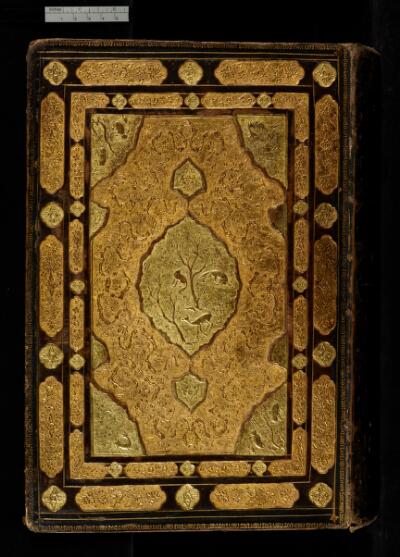
ʻAjāʼib al-makhlūqāt (MS Nn.3.74)
The cosmography of Qazwini
- Author
- Qazwīnī, Zakarīyā ibn Muḥammad, ca. 1203-1283
- Language
- Persian
- Date
- 974 AH / 1566 CE
- Library
- Cambridge University Library
- Shelfmark
- MS Nn.3.74
- Images
- 496
Scroll or pinch to zoom, drag to move, and use ← → to turn pages. Images © the holding library.
Description
<p style='text-align: justify;'><p>A richly illuminated 16th Century [CE] copy of the Persian version of Qazwini's ʻAjāʼib al-makhlūqāt wa-gharāʼib al-mawjūdāt, "The marvels of creation and the oddities of existence", commonly known as "The cosmography of Qazwini"..<br /><br /> The text is structured according to a hierarchical cosmological order, with the <a href='http://cudl.lib.cam.ac.uk/view/MS-NN-00003-00074/27'>celestial spheres</a>, incorporating the fixed stars, the <a href='http://cudl.lib.cam.ac.uk/view/MS-NN-00003-00074/49'>12 signs of the Zodiac</a>, stellar constellations and the <a href='http://cudl.lib.cam.ac.uk/view/MS-NN-00003-00074/35'>surrounding spheres</a>, which make up the observable celestial phenomena, followed by the invisible phenomena, the <a href='http://cudl.lib.cam.ac.uk/view/MS-NN-00003-00074/67'>"Guardians of the Kingdom of God"</a> and other angels, and the division of time and calendars.<br /><br /> In the second section of the work the elemental division of the sublunar sphere is classified into the four elements fire, <a href='http://cudl.lib.cam.ac.uk/view/MS-NN-00003-00074/100'>wind</a>, <a href='http://cudl.lib.cam.ac.uk/view/MS-NN-00003-00074/104'>water</a> and earth. The seas, oceans and islands including their inhabitants, are governed by Water, while Earth contains the mountains, wells, rivers, <a href='http://cudl.lib.cam.ac.uk/view/MS-NN-00003-00074/190'>minerals</a>, <a href='http://cudl.lib.cam.ac.uk/view/MS-NN-00003-00074/216'>plants</a> and the <a href='http://cudl.lib.cam.ac.uk/view/MS-NN-00003-00074/267'>animal kingdom</a>, including human beings and their cultures.<br /><br /> Numerous illustrations of commonly known <a href='http://cudl.lib.cam.ac.uk/view/MS-NN-00003-00074/435'>mammals</a>, <a href='http://cudl.lib.cam.ac.uk/view/MS-NN-00003-00074/455'>birds</a>, <a href='http://cudl.lib.cam.ac.uk/view/MS-NN-00003-00074/472'>insects</a> and <a href='http://cudl.lib.cam.ac.uk/view/MS-NN-00003-00074/476'>reptiles</a> can be found, along with <a href='http://cudl.lib.cam.ac.uk/view/MS-NN-00003-00074/483'>strange beings</a>, which conclude the text.</p><p>Transcription produced by <a target='_blank' class='externalLink' href='https://kairawan.org/'>Kairawan AI</a></p></p> A richly illuminated 16th Century [CE] copy of the Persian version of Qazwini's ʻAjāʼib al-makhlūqāt wa-gharāʼib al-mawjūdāt, "The marvels of creation and the oddities of existence", commonly known as "The cosmography of Qazwini".. The text is structured according to a hierarchical cosmological order, with the celestial spheres, incorporating the fixed stars, the 12 signs of the Zodiac, stellar constellations and the surrounding spheres, which make up the observable celestial phenomena, followed by the invisible phenomena, the "Guardians of the Kingdom of God" and other angels, and the division of time and calendars. In the second section of the work the elemental division of the sublunar sphere is classified into the four elements fire, wind, water and earth. The seas, oceans and islands including their inhabitants, are governed by Water, while Earth contains the mountains, wells, rivers, minerals, plants and the animal kingdom, including human beings and their cultures. Numerous illustrations of commonly known mammals, birds, insects and reptiles can be found, along with strange beings, which conclude the text.Transcription produced by Kairawan AI
Readers’ comments (0)
No comments yet. Be the first to comment.
Comments with photos or links are published after review.
More manuscripts
 Persianخمسه.
Niẓāmī Ganjavī, 1140 or 1141-1202 or 1203 · Princeton University Library
 PersianSafinah fragment
imad al-hasani al-katib · Library of Congress
 PersianInsha'
khan zaman · Library of Congress
 Arabic[Collection of alphabets and encoded correspondence]
Princeton University Library
 PersianQuatrain on divine mercy
mir 'ali heravi (attr.) · Library of Congress
 PersianMunshaʼāt-i Ḥaz̤rat-i Nābī Afandī
OPenn — University of Pennsylvania
 Persian[Calligrapher's sample book.]
ḥusaynī, ḥasanʻalī · Library of Congress
 Persianگلشن عشق.
Nuṣratī, -1673 · Princeton University Library